
Shots written as code
Every take on the site is a scene document, not a recording: the map, the time of day and the weather, the cast and its paint, each tank's route and speed, where each gun points, the camera's rail and the moment for its still. tools/media-r5/site50.mjs writes all fifty from one table, so a change to the plan reaches every take that shares it. The shot library keeps each take's scene exactly as the Studio saves it, so a take opens in the Studio from a link: the viewer below opens every featured take that way.
Each round is directed with notes: the lens on a three-dimensional track that swings close and far, tanks fast in every direction, fronts and quarters rather than rears, and a list of tanks that each lead a take of their own. Every round renders into folders of its own, so earlier versions stay beside the code that made them.
One take, every stage
Round four is the first loop, before the motion note. Engine review 1 is the first motion plan rendered small in the engine, with everything it caught. Previz is round six's plan as a schematic camera, and engine review 2 is that plan in the engine after the fixes. Engine review 3 is round seven: the plan re-staged on the 2.0 maps, the scenes the 4K finals render from.
The process
Ten steps take a shot from a note to the website. The checks run before any GPU time is spent, and every fix lands in the engine, the tools or the plan, never in a single frame.
Motion search and previz
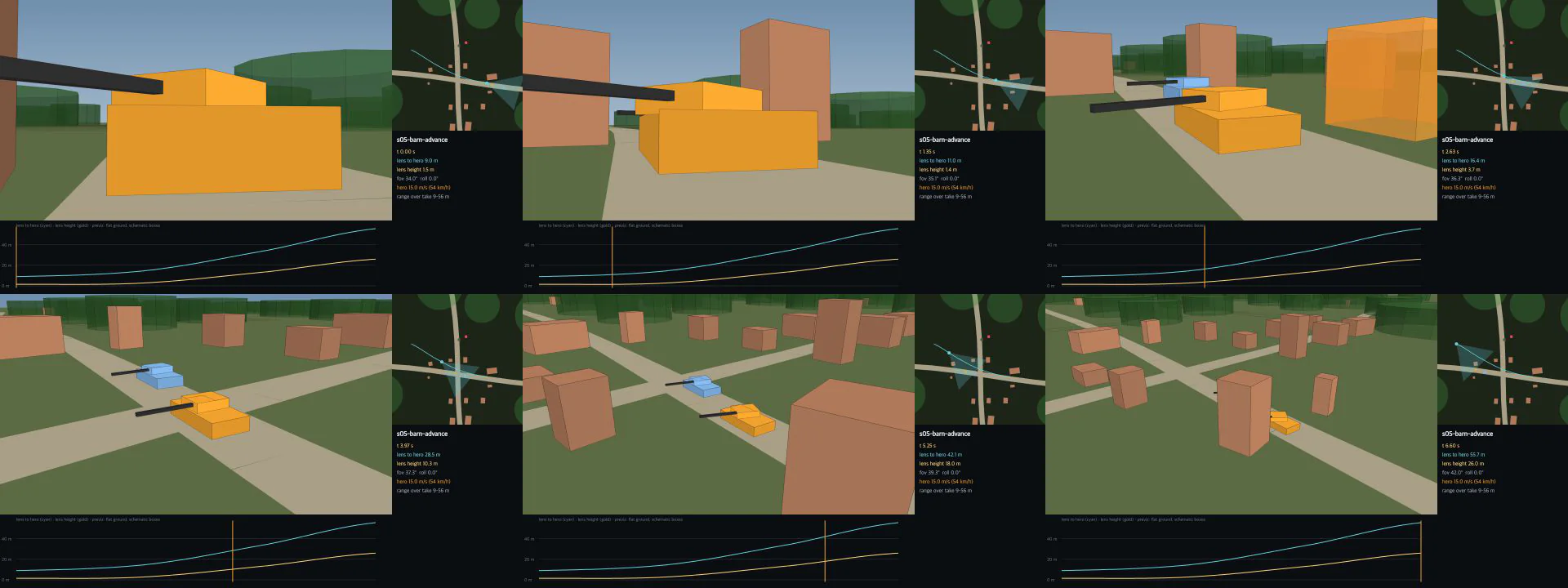
The motion search staged all 50 site takes and all 166 fleet takes. For each take it tries road and open-ground routes, columns and fans of escorts, guns held on their own targets and lens moves by kind (a swoop, a lead reveal, an orbit that rises, a cable run, a weave, an overtake), and it scores every candidate for close-to-far range, climb, front angles, speed and flank swings. The winners are written to a tracked plan file.
Previz draws each plan as a schematic camera's eye beside the map, with the lens's distance and height across the take. Choreography is judged here, in seconds per take, before a single frame is rendered.
The battlefield as the engine holds it
A survey of each map in the running game dumps every collision record (its footprint, height, crush threshold and canopy) with a 4 m grid of ground heights and water. An offline model rebuilds the battlefield from that dump and answers with the engine's own collision code.
Routes are checked against it in 50 ms steps: a hull may crush what a battle hull would crush, and anything else fails the route, as does a start inside a building or a slope too steep to climb. The lens check samples the camera every 100 ms and casts five sightlines to the hero (its centre, nose, tail and both flanks) through every record and canopy; low cover never blocks, and a prop counts only when it is large on screen against the tank.
What the Studio gained
A spline camera rail keeps fast moves smooth through every key. Each tank drives its own route at speed with its gun stabilised on a target, and a travel frame lets the lens ride a swerving tank without swinging with it. The Plan view shows the take from above (every route, the camera's track and view, the lens's distance and height) and scrubs with the timeline.
Tanks on the timeline now crush what they overrun, by the battle's own rule: a hull fells a fence, a wall or a tree when it runs over it faster than that object gives way. The crushes are planned from the routes before playback, fire live as the timeline plays and replay settled after a seek, so any frame shows the same wreckage. At night the Studio's camera holds a moonlit exposure, 1.25 stops under the map's, instead of adapting the dark back toward day.
The engine review
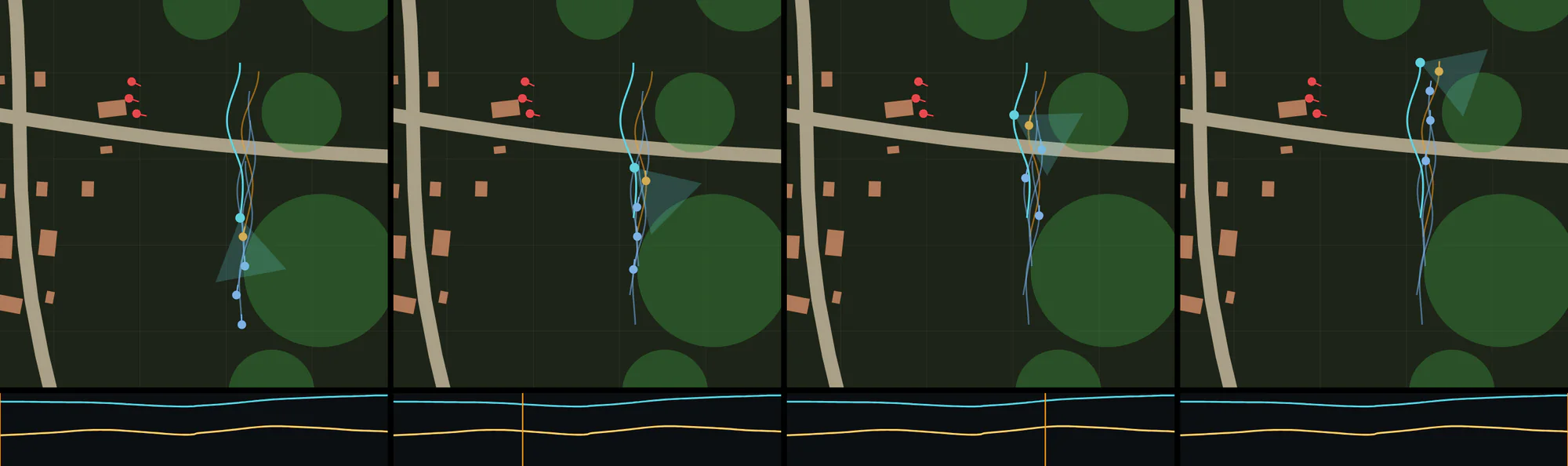
All fifty takes were rendered small in the game engine before any final. The first review caught three things the schematic could not: tanks driving through intact props in about half the takes, props in front of the lens in six, and eight night takes lit like day under a starry sky.
Each fix went to its source: the Studio's crushes, the battlefield model and its lens check, and the night camera. The second review renders every take again at 960 pixels with a light probe on each. When the 2.0 maps changed the battlefields, the motion search re-staged the takes the new layouts broke, and a third review rendered all fifty on them before the finals start.
4K finals and stills
Finals render at 3840 × 2160 and 30 frames per second, in deep focus: sharp from the lens to the horizon, with no depth-of-field blur in front of the tanks. Each frame is the average of 8 to 48 complete renders at sub-pixel offsets across a 60° shutter; fast motion adds renders until neighbouring ones are at most 1.5 pixels apart. The jittered average replaces the game's temporal anti-aliasing, bloom and the grade run once on the average, and a sharpening pass finishes the frame.
Each take also renders two 4K stills at a 2 ms exposure: its key moment and a close portrait where the tank is largest on screen, each chosen with the whole tank in frame, centred, nothing in front of it and no burst of dust just before. About a hundred stills become posters, key art and social images; the films' ProRes masters are kept, and the site's formats are encoded from them.
Sound
Nothing in the films' sound is synthesized. The battle effects are the game's own recordings, placed from each cut's edit list with the engine's resolvers (the gun's class, the engine family, the track set, the map's echo tail and its ambience), and the hero's crew calls its shots on the radio, in its own language, over the engine's intercom chain.
The score is generated with Eleven Music from a composition plan written from the cut's cue sheet. Its hits (braams in the sheet's chords, a sub boom, risers, a reverse swell and taiko) are generated sound effects, several takes each; the best measured take is kept and placed on its downbeat. Each film is mastered to −14 LUFS.
The films and the board
Four films are cut from the takes as HyperFrames compositions: a trailer, a 30-second cut, a 15-second vertical and the lineup. Their edit lists are generated from the takes, and the HTML compositions render frame-exact to video.
The owner reviews every round on one board: each take's frames, previz, engine reviews and finals side by side, with the receipts of every change. Notes go back into the plan, the engine or the tools, and the next round renders beside the last.