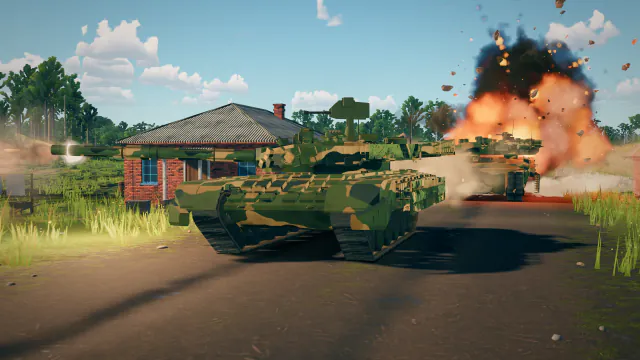
Start with hard constraints
The project is browser-native and built directly on Three.js rather than a general game engine. The simulation runs at a fixed 60 Hz, playable tanks use first-party procedural runtime geometry, and presentation pages stay isolated from the heavy game boot graph.
Those constraints shaped the architecture: deterministic rules can run in Node, the renderer adapts independently, and every public claim can point to code, a test, a capture, or a measured receipt.
Separate rules from presentation
Movement, ballistics, armor, damage, spotting, match state, and bot decisions live behind renderer-free contracts. Three.js turns the latest state into cameras, rigs, lighting, effects, audio, and UI without becoming the authority for a hit.
That boundary lets local battles and browser-hosted rooms share the same combat rules. It also lets lower-end visual settings reduce cost without changing gameplay.
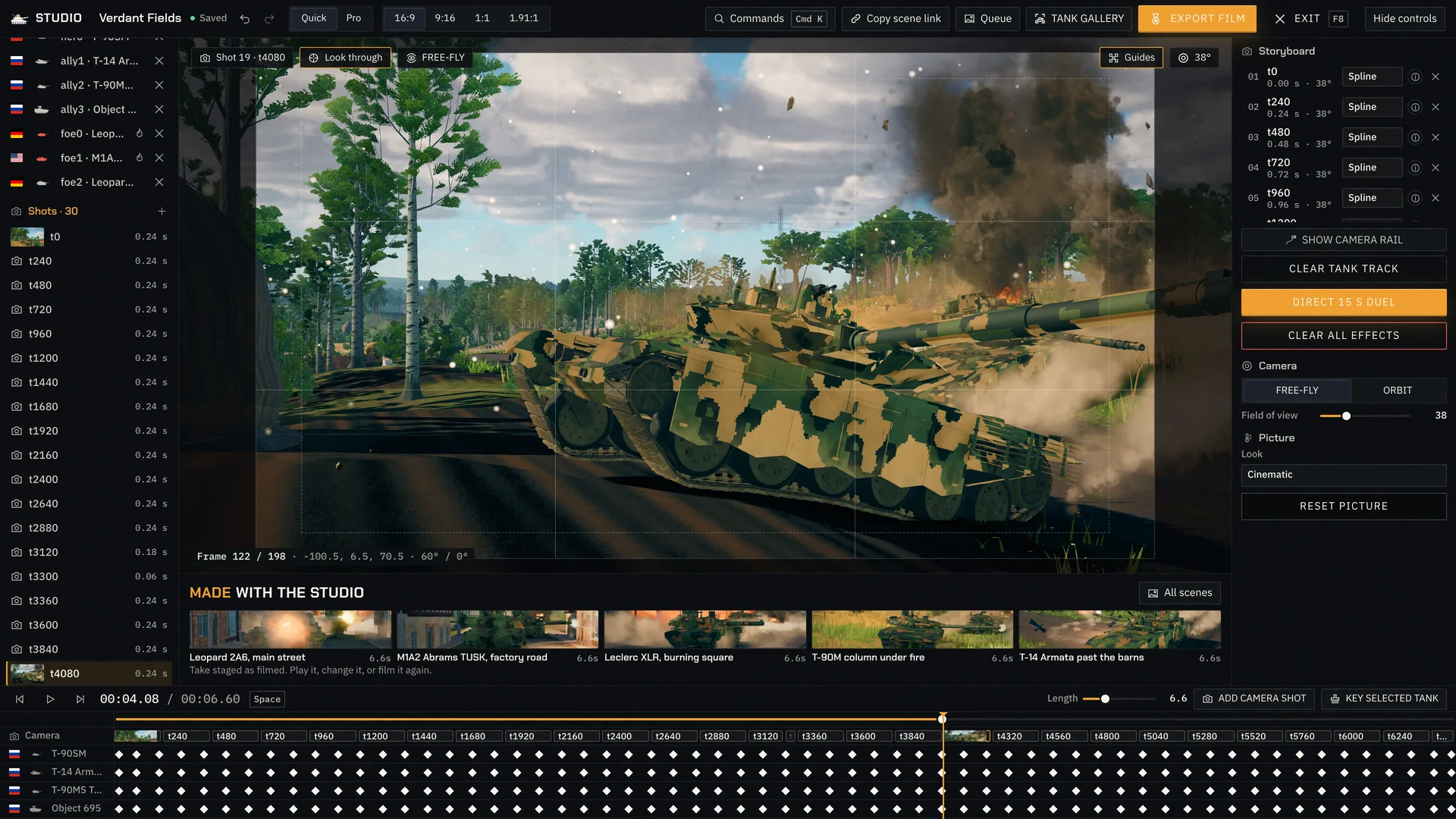
Claude Code and Codex workflow
Claude Code and Codex were used as development tools across bounded tasks. Broad or risky work moved into isolated Git worktrees; each lane named the files it owned, preserved unrelated changes, and exchanged exact commit hashes and evidence before integration.
The working rule was simple: main stays current, unfinished experiments stay isolated, and a branch is not proof. Only the integrated bytes count. Human direction set the target and acceptance bar; agents implemented, measured, reviewed, and documented against it.
Build, falsify, and measure
A typical round starts with a reproducible baseline, then attribution. The smallest plausible fix is tested with focused self-tests, browser interaction, console inspection, screenshots, and performance probes. A result must survive a second run or a deliberately hostile case before it is accepted.
Visual work is judged from current pixels, not only numeric checks. Performance work records cold and warm conditions, device constraints, long tasks, frame gaps, GPU resources, and transition timings instead of reporting a single FPS number.
Make the workflow durable
Repository-level AGENTS.md, indexed subsystem SKILL.md files, and one maintained architecture decision record preserve ownership, invariants, required commands, and recurring failure modes without burying contributors in completed migration notes.
When a manual process repeats, it becomes a script or a gate. That is why model screenshots, combat anatomy, vehicle icons, route probes, public metadata, and release checks are reproducible from the repository. Raw execution receipts stay in Git history or ignored QA artifacts.
Land only integrated proof
A finished change is committed as one coherent unit, rebased on the latest origin/main, and rechecked after integration. The final push verifies that its parent is still the remote tip so concurrent work cannot silently overwrite a newer landing.
The public build then proves route isolation and writes a provenance receipt that hashes every file of its source tree. This keeps the playable site, source tree, documentation, and main branch describing the same game.